_misc48.gif)
Ancient alchemists believed that, under the correct astrological conditions, lead could be "perfected" into gold. They tried to hasten this transformation by heating and refining the metal in a variety of chemical processes, most of which were kept secret. Alchemy was practiced in much of the ancient world, from China and India to Greece. It migrated to Egypt during the Hellenistic period and was later revived in 12th-century Europe through translations of Arabic texts into Latin. Medieval European alchemists made some useful discoveries, including mineral acids and alcohol. The revival led to the development of pharmacology under the influence of Paracelsus and to the rise of modern
Alchemy is an art of ancient origins. It can be interpreted as an enquiry into man's relationship with the cosmos and the will of the Creator, manifested as either a devotional philosophy transforming sinful man into perfect being (‘esoteric’), or attempted transmutation of base metals into gold or silver (‘exoteric’). The catalyst required was the elixir of life, tincture, or philosophers' stone, the search for which long obsessed men of all ranks.
Probably arising in Hellenistic Alexandria, alchemy (al-kimia) was transmitted to Europe through Islamic culture. Whilst earlier Taoist alchemists had aimed principally for longevity, medieval western alchemists' objectives were gold-making or creating superior medicines. Since the gold-makers' skills rendered them vulnerable to avaricious magnates, circumspection was advisable, but public credulity encouraged conjuring and dishonesty. Practical alchemy, nevertheless, had much to offer medicine, giving rise to metallic rather than herbal remedies, much favoured by Paracelsus, and eventually to iatrochemistry.
Since the early alchemists were mainly artisans, they tried to conceal the secrets of their work; thus, many of the materials they used were referred to by obscure or astrological names. It is believed that the concept of the philosopher's stone (called also by many other names, including the elixir and the grand magistery) may have originated in Alexandria; this was an imaginary substance thought to be capable of transmuting the less noble metals into gold and also of restoring youth to the aged. Alchemy, strongly tinged with magic, reached the Arabs (perhaps in the 8th cent.) and remained for several centuries under Muslim influence; in the 12th century it reached parts of Europe through translations of Arabic writings (the early Greek treatises were not known in Europe in the Middle Ages). Arab alchemy was preserved especially in the works of Jabir and the earlier Greek alchemy in those of Zosimus and others. The alchemical writings of the Middle Ages continued to be couched in symbolic and cryptic language. The alchemists became obsessed with their quest for the secret of transmutation; some adopted deceptive methods of experimentation, and many gained a livelihood from hopeful patrons. As a result, alchemy fell into disrepute. However, in the searching experimental quests of the alchemists chemistry had its beginnings; indeed, the histories of alchemy and chemistry are closely linked. Transmutation of elements has been accomplished in modern chemistry.
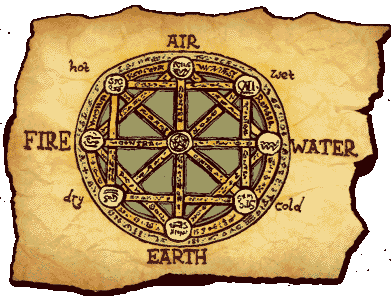
Aristotle's Elements Chart above
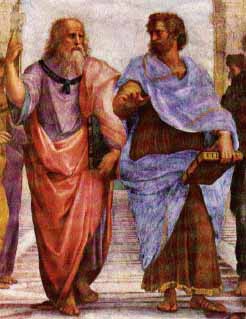
Plato and Aristotle
Aristotle was born in Stagira in north Greece, the son of Nichomachus, the court physician to the Macedonian royal family. He was trained first in medicine, and then in 367 he was sent to Athens to study philosophy with Plato. He stayed at Plato's Academy until about 347 -- the picture at the top of this page, taken from Raphael's fresco The School of Athens, shows Aristotle and Plato (Aristotle is on the. right). Though a brilliant pupil, Aristotle opposed some of Plato's teachings, and when Plato died, Aristotle was not appointed head of the Academy. After leaving Athens, Aristotle spent some time traveling, and possibly studying biology, in Asia Minor (now Turkey) and its islands. He returned to Macedonia in 338 to tutor Alexander the Great; after Alexander conquered Athens, Aristotle returned to Athens and set up a school of his own, known as the Lyceum. After Alexander's death, Athens rebelled against Macedonian rule, and Aristotle's political situation became precarious. To avoid being put to death, he fled to the island of Euboea, where he died soon after.
Aristotle is said to have written 150 philosophical treatises. The 30 that survive touch on an enormous range of philosophical problems, from biology and physics to morals to aesthetics to politics. Many, however, are thought to be "lecture notes" instead of complete, polished treatises, and a few may not be the work of Aristotle but of members of his school.
A full description of Aristotle's contributons to science and philosophy is enormous, but a brief summary can be made: Whereas Aristotle's teacher Plato had located ultimate reality in Ideas or eternal forms, knowable only through reflection and reason, Aristotle saw ultimate reality in physical objects, knowable through experience. Objects, including organisms, were composed of a potential, their matter, and of a reality, their form; thus, a block of marble -- matter -- has the potential to assume whatever form a sculptor gives it, and a seed or embryo has the potential to grow into a living plant or animal form. In living creatures, the form was identified with the soul; plants had the lowest kinds of souls, animals had higher souls which could feel, and humans alone had rational, reasoning souls. In turn, animals could be classified by their way of life, their actions, or, most importantly, by their parts.
Though Aristotle's work in zoology was not without errors, it was the grandest biological synthesis of the time, and remained the ultimate authority for many centuries after his death. His observations on the anatomy of octopus, cuttlefish, crustaceans, and many other marine invertebrates are remarkably accurate, and could only have been made from first-hand experience with dissection. Aristotle described the embryological development of a chick; he distinguished whales and dolphins from fish; he described the chambered stomachs of ruminants and the social organization of bees; he noticed that some sharks give birth to live young -- his books on animals are filled with such observations, some of which were not confirmed until many centuries later.
Aristotle's classification of animals grouped together animals with similar characters into genera (used in a much broader sense than present-day biologists use the term) and then distinguished the species within the genera. He divided the animals into two types: those with blood, and those without blood (or at least without red blood). These distinctions correspond closely to our distinction between vertebrates and invertebrates. The blooded animals, corresponding to the vertibraetes, included five genera: viviparous quadrupeds (mammals), birds, oviparous quadrupeds (reptiles and amphibians), fishes, and whales (which Aristotle did not realize were mammals). The bloodless animals were classified as cephalopods (such as the octopus); crustaceans; insects (which included the spiders, scorpions, and centipedes, in addition to what we now define as insects); shelled animals (such as most molluscs and echinoderms); and "zoophytes," or "plant-animals," which supposedly resembled plants in their form -- such as most cnidarians.
Aristotle's thoughts on earth sciences can be found in his treatise Meteorology -- the word today means the study of weather, but Aristotle used the word in a much broader sense, covering, as he put it, "all the affections we may call common to air and water, and the kinds and parts of the earth and the affections of its parts." Here he discusses the nature of the earth and the oceans. He worked out the hydrologic cycle: "Now the sun, moving as it does, sets up processes of change and becoming and decay, and by its agency the finest and sweetest water is every day carried up and is dissolved into vapour and rises to the upper region, where it is condensed again by the cold and so returns to the earth." He discusses winds, earthquakes (which he thought were caused by underground winds), thunder, lightning, rainbows, and meteors, comets, and the Milky Way (which he thought were atmospheric phenomena). His model of Earth history contains some remarkably modern-sounding ideas.Where Aristotle differed most sharply from medieval and modern thinkers was in his belief that the universe had never had a beginning and would never end; it was eternal. Change, to Aristotle, was cyclical: water, for instance, might evaporate from the sea and rain down again, and rivers might come into existence and then perish, but overall conditions would never change.
In the later Middle Ages, Aristotle's work was rediscovered and enthusiastically adopted by medieval scholars. His followers called him Ille Philosophus (The Philosopher), or "the master of them that know," and many accepted every word of his writings -- or at least every word that did not contradict the Bible -- as eternal truth. Fused and reconciled with Christian doctrine into a philosophical system known as Scholasticism, Aristotelian philosophy became the official philosophy of the Roman Catholic Church. As a result, some scientific discoveries in the Middle Ages and Renaissance were criticized simply because they were not found in Aristotle. It is one of the ironies of the history of science that Aristotle's writings, which in many cases were based on first-hand observation, were used to impede observational science.

